People in the cityscape
You'll learn to place figures convincingly into a street scene at different distances and in groups, and to avoid the typical mistakes.
20 min
A city view without people looks like a stage set before the show. It's the figures that tell you this place is lived in, and they reveal how big the houses, bridges and squares really are. In this lesson you bring together everything you've learned and place people in your drawing so that they truly belong there.
Size by distance
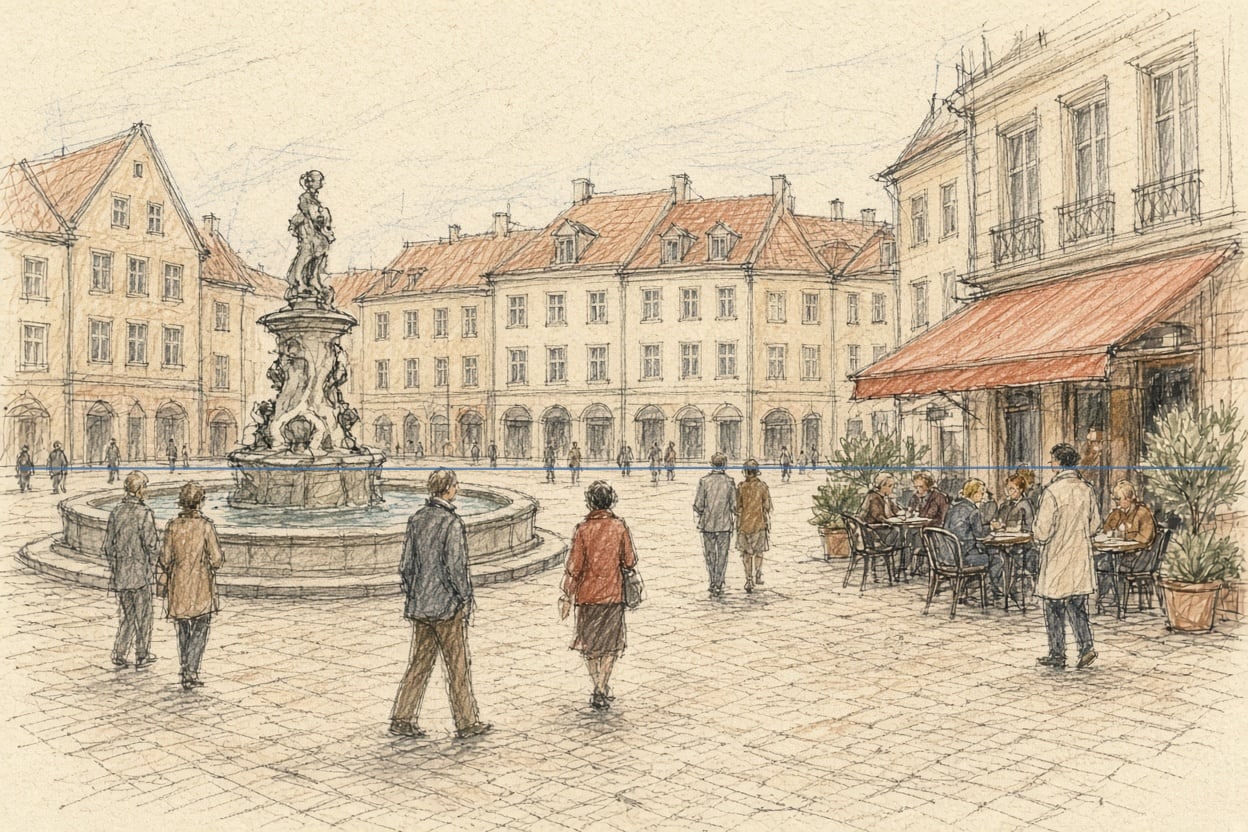
The further away a person is, the smaller they appear. You know that, but while drawing it's easy to forget, and you end up making all the figures roughly the same size. Then the people in the background stand around like giants.
The rule from the lesson on movement helps here: if you're standing, every head sits at eye level. So draw the horizon line first. A nearby figure has its feet low down in the picture; a distant one has its feet just below the line. The head always stays on the line, and the rest follows. That way the sizes work out automatically, without any measuring.
Work with three distances. In front, one or two larger figures with some posture and clothing. In the middle, several medium-sized ones with stick figure and torso. At the back, small figures that are hardly more than a dot for the head and a vertical stroke.
Figures in groups
People are rarely on their own. They sit in pairs at a table, crowd together at the tram stop, cross the square as a family. Don't draw a group as a row of separate figures; draw it as one connected shape. The heads sit at similar heights, the bodies overlap, one partly hides another. Those overlaps create depth and make the group believable.
Vary things within the group: a child with a larger head and shorter body, someone with a bag, someone in contrapposto, someone turning aside. Two or three differences are enough to bring the group to life.
People as a sense of scale
A doorway with nobody in front of it could be two metres high or twenty. Put a figure there and everyone understands at once. Use that on purpose. A tiny person at the foot of a church makes it monumental; a figure that nearly fills the door reveals a narrow lane. Make sure the feet stand on the same ground as the building, or the scale won't hold.
Colour and shadow in one go
Figures in a cityscape don't get a long colour session of their own. Choose one colour per figure, say for the jacket, and lay it in with a single brushstroke without trying to hit the outline exactly. A touch of skin tone for the head, and you're done. A strong colour on a small figure is often the best accent in the whole picture.
Then comes the most important part: the cast shadow on the ground. A short, dark stroke under the feet, running in the same direction as the shadows of the buildings, anchors the figure. The feet touch this shadow. Without it, people float above the paving.
Typical mistakes
Three mistakes show up in almost every beginner's sketchbook. First, heads that are too big: the figure looks childlike or like a caricature. Count the head units; adults need just under 8. Second, floating feet without a shadow, as above. Third, stiff arms stuck to the body like rods. Give the arms a bend at the elbow, let them swing or carry something, and the figure comes to life.
Exercise
Find a street scene with buildings and people: a square, a shopping street, the forecourt of a station, or a photo of one. You have 20 minutes. In the first 8, draw the horizon line and block in the buildings roughly. Then add figures at three distances, every head at eye level, with at least one group with overlaps and one figure beside a door for scale. To finish, give some of the figures a colour in one go and all of them a cast shadow. Photograph the page and show it to the coach.