Head units: measuring the body
You'll learn to measure the human body in head heights and to know the key proportions, so your figures look convincing from the first line.
15 min
Module 1. Head units: measuring the body
Back repeats the current paragraph; tap twice to go to the previous one.
When a figure in your sketchbook looks odd, the line is rarely to blame. Usually the relationships are off: the head too big, the legs too short, the arms stopping somewhere around the belly button. The good news is that you don't need to study anatomy to fix this. To start with, one single measurement is enough, and you always carry it with you: the height of the head.
The head as your unit
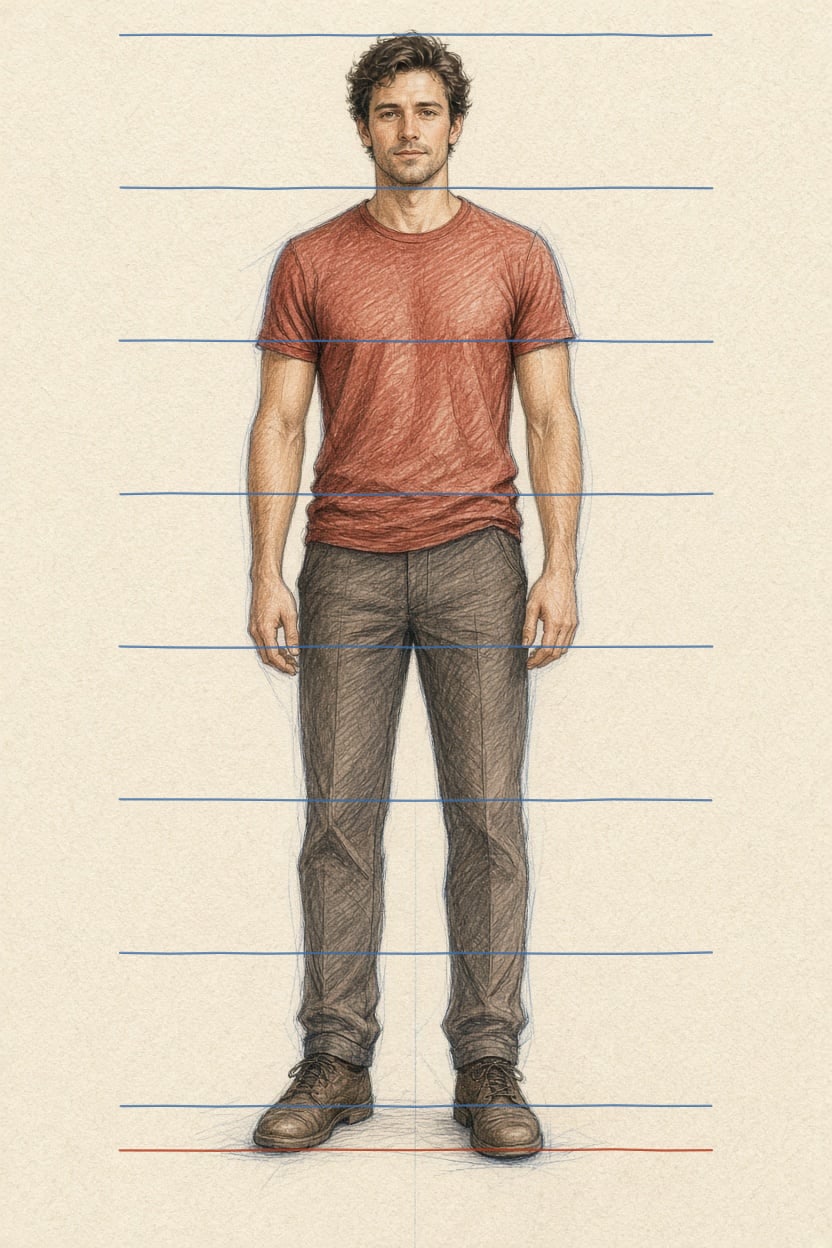
People who draw have measured the body in heads for centuries, counting from the top of the skull to the tip of the chin. An adult is roughly 7½ to 8 heads tall. For sketching on location, the easiest thing is to work with just under 8: it looks natural and divides up neatly.
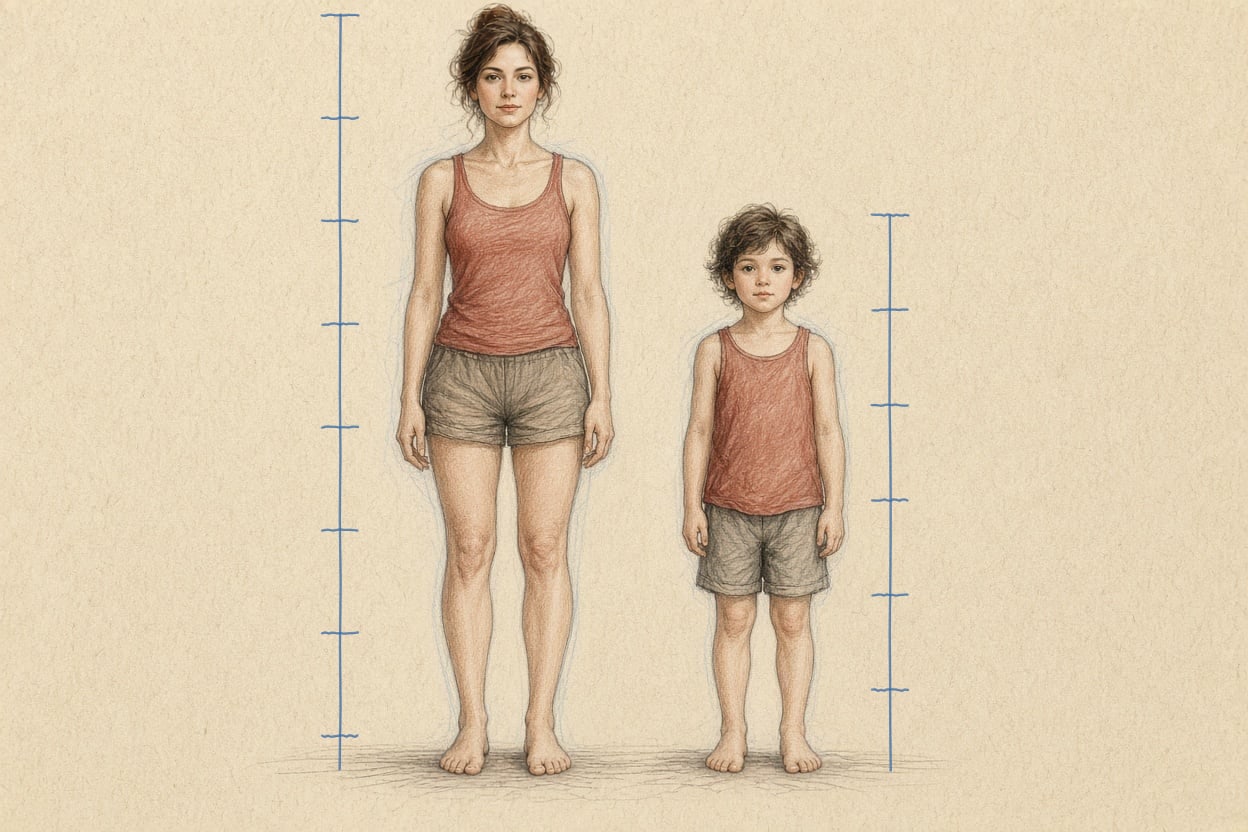
In children the head is much larger in proportion. A toddler is only about 4 heads tall, a primary-school child around 5, a teenager 6 to 7. That's exactly why children in sketches often look older than they are: we draw them as small adults. Give them a bigger head and shorter legs, and they instantly look younger.
The main landmarks
Split a vertical line into eight equal parts and you have a scaffold. The midpoint of the body falls roughly at the crotch, right where the legs begin. So the top half and the bottom half are about the same length, which surprises many people, because we tend to think of the legs as shorter.
Shoulders are about 2 heads wide on men and more like 1½ to 1¾ on women. It's one of the clearest differences in the silhouette, and it helps you tell people apart even from a distance.
For the arms, remember three points. With the arm hanging loose, the elbow sits at waist level. The wrist reaches roughly to the crotch. The fingertips end around the middle of the thigh. If your figures have arms that barely get past the hip, now you know why.
The knee sits about 5½ to 6 heads down from the top of the head. The lower leg and foot take up the rest of the way to the ground.
Measuring with your pencil
Out on the street you won't have a ruler, and you don't need one. Stretch your arm out fully so that the distance between your eye and the pencil stays the same every time. Close one eye. Hold the pencil upright, line the tip up with the top of the person's head and slide your thumb down to the chin. That's your unit. Now you can count how many times it fits into the whole figure.
The straight arm is what matters. If you bend it, every measurement comes out different and the proportions drift. With a bit of practice you'll only measure at the start; after that, your eye will judge on its own.
Averages, not rules
These numbers describe an average. The person opposite you on the tram may have long legs and a short torso, wide hips or narrow shoulders. That's exactly what makes them recognisable. Use head units as a starting point, then look for where this person departs from them. That departure is the interesting part, not a mistake.
Clothing changes what you see, too. A thick coat widens the shoulders, heels lengthen the legs, a woolly hat adds height to the head. Measure what's visible and imagine the body underneath.
Building a figure
Put a small mark at the top for the head and at the bottom for the feet. Halve the distance: that's the crotch. Halve the top half and you'll find roughly the chest line, with the head and shoulders above it. Halve the bottom half and you're about at the knee. With those three divisions you get a sound framework in seconds, without having to count eight marks.
Exercise
Find a place where people stand still for a while: a tram stop, a queue outside a café, a station platform. If nobody's around, use photos of people standing. Draw five standing figures, about 3 minutes each. First mark the top of the head and the feet, divide into halves and quarters, then place the crotch, knees, shoulders, elbows and fingertips. For at least two of the figures, check your measurements with the pencil at arm's length. Next to each figure, write down how many heads you counted. Photograph the page and show it to the coach.
The illustrations in this course were generated with an image model and checked by us; we measured and drew the guide lines and head units ourselves.